
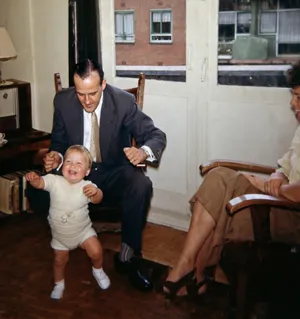
Toddlerhood
My parents, Marinus Jurg and Lucy Visser, married on May 31, 1955, and took a flat in Schiedam, where my father had gone to work at Itho. On February 2, 1960, he died of a brain hemorrhage, mid-negotiation with Amstel over a cooling system he had designed himself. Healthy negotiation has been a priority of mine ever since.
My first memory is my mother saying, “Your father is no longer here”. And then me searching. The kitchen. Under the bed. The closet. At some point I stopped enjoying this ‘game’ and decided, ‘consciously’, never again to look for someone who did not ‘want’ to be found. Only much later did I understand that it had never been a matter of wanting but of being able, and even then I understood it only cognitively. Emotionally I went on believing for years that if I searched hard enough, I would find my father. That is where I learned to tell thinking, feeling and wanting apart.
When he died, my mother was four months pregnant with my sister. She wanted to be wholly present at my father’s deathbed, so I was taken to an uncle and aunt in The Hague. I was not at the funeral either. Comfort was missing, and the grief had to wait years to be processed. Seeing a thing for yourself, however painful, is what lets you put it down.
My mother named my sister after my father: Marina. So I learned early what a name can carry, and what a date can. I learned, too, that “the man of the house”, as everyone said, was to take good care of his mother and his sister. Care and responsibility, installed early. Small wonder that Freud’s insistence on childhood experience, and on the work of becoming aware of it, has never needed explaining to me.
Early childhood
On November 21, 1962, my mother remarried: Jurriaan Jurg, an older brother of my father, who had lost his own wife to cancer three months before. We moved in with them in Utrecht. During the honeymoon I was left with Uncle Klaas, who let me experience “what daddies do with their children, because I don’t know.” What began as a feeling of being deeply understood turned into dissociation. It made me permanently alert to the power of an empathetic, credible story, and to how much authenticity and integrity that story needs. It also taught me that people in mourning need extra protection, and left me wanting to contribute to a safe world in which ‘unfair’ events get processed together.
My three cousins and my niece were now my stepbrothers and stepsister. Every one of my father’s brothers had named his eldest son Wim, so I went from being the strong man of the house to little Wim. Being relieved of my caregiving duties was a relief. Suddenly counting for nothing at all was not, and neither was sensing that my new brothers would sooner be rid of me than have me around. So I learned early that roles are temporary and that different circumstances ask for different behavior. My great ‘anchor’ was my sister Marina, three years younger. Essentially, she still is.
Primary school
In May 1963 we moved to Voorthuizen. On December 22, 1963, my half-brother was born, a sign of a bond his parents approved of and not one of the ‘real’ children did. Because my (new) ‘father’ had the same surname as me and Big Wim had not moved with us, nobody noticed he wasn’t my father. I looked like everyone else now; everything was ‘normal’ again. Things are not always what they seem.
Meanwhile I felt I was denying my real father in a world of pretty pictures. In the secret photo in my nightstand drawer he is still the tough, big captain and stopper of the football team. Football was, then, my great passion, and Johan Cruyff my great living hero. I shared, subconsciously, the tragedy of a father who died too young. Mine never came back to play football with me alongside the stars of yesteryear, the way it happens in the film In Oranje. Sometimes you only see a thing once you understand it.
In 1968 I missed the final of the provincial school football tournament because I had to go into hospital for my nose; I sniffed a great deal, unable to breathe or blow it properly. When I came round from the operation, the ENT doctor had removed my entire nasal bone down to the base, under the motto: “When you’re an adult, you’ll get an artificial nose.” Nose proverbs have been traumatic ever since. The same saying can land very differently on different people.
High school
I was good at studying, so I went to the gymnasium in Ede. I still remember how cool I thought that was; my company therapist, Marten Disberg, calls that ego. When someone felt the need to make a ‘funny’ remark about my nose, I would say something like: “I have a boxer’s nose: I was the boxing champion of my primary school.” Invented stories, it turns out, are excellent at curbing that kind of ‘joke’.
In my second year my second ‘father’ died. To my own surprise I scored a 1, the lowest grade there is, on the English test the next day, though I was sure I had ‘simply’ studied well. Some events carry far more weight than we credit them with. At the funeral I was struck by how differently condolences landed: some gave me an enormous sense of being understood, and some produced something close to ‘disgust’, because they didn’t feel ‘real’ and I could feel someone else’s grief being poured out over me. You can feel authenticity. These days I call it physical validity. That my ‘second father’ was buried with his first wife was alienating and comforting at once: at least it was a visible acknowledgment that he was not my father. Nothing has taught me more about the importance of a good conclusion.
Besides fairy tales, which for me ended inspiringly and hopefully with “and they lived happily ever after”, my favorite thing in Trouw during high school, sports aside, was the back page: Useless Knowledge, knowledge with no bearing whatsoever on my daily existence. My great hobby was adapting and inventing game rules: checkers, chess, a battery of my own games, and, in 1968 and 1969, a contribution to the development of Space Race under Gert-Jan van Elten, the enterprising father of a friend. He never managed to sell that good game, not even at the ultimate moment, the first step on the moon in 1969. Bringing something to market successfully is evidently not just a good product at the right time in the hands of a good marketer. Apparently it is also about recognizing and acknowledging your own position within the market system.
Studies (1975-1982)
I went to university because I enjoyed knowledge that wasn’t directly applicable. I chose econometrics for its motto: to measure is to know. The adjustment was steep: I had landed among the brainy. In primary school I sat at the front, because we were seated from the smartest downwards and I was the best; now I passed my propaedeutic exam 21st of 66, which is to say last. Professor Rijken Van Olst’s econometric prediction at the introduction, “Look left, look right; I will only see one of you three again next year”, proved quantitatively accurate. Qualitatively it had its shortcomings, as I noticed at the end of the year: I had ‘coincidentally’ landed in a subgroup of seven, six of whom passed. Statistics are only accurate at a high level of aggregation.
Fortunately, I also discovered I was the best football player of the lot, and ‘so’ I organized an annual match between the students and the staff. There is always and everywhere something to be found in which you can contribute to the whole.
To develop the ‘human dimension’, I began studying psychology after my bachelor’s in econometrics. I joined every kind of group therapy the doctoral program offered, which gave me room to properly process (my) deep grief and to discover the importance of taking personal responsibility for what I needed. It takes courage to take charge of your own life, and loneliness comes from not speaking about your shadow side. I learned that life is “delightful and terrible” at the same time, that body and mind are a phenomenological whole, and how wonderful (Rogerian) empathy is.
What also stuck was how completely the two cultures differed. In econometrics the professor’s personality and your fellow students were irrelevant; after seven years I knew the surnames of a small handful of people. In psychology, a series of six meetings spent two on getting acquainted and two on evaluation and goodbyes; one third of the time went to the content. A difference in background is not only a matter of knowing different things, then, but of approaching everything differently.
Soccer coach (1977-1993)
Useless knowledge no longer held me; I wanted to do something with what I had learned. My ‘side job’ as a football trainer and coach at Astrea was one place to do it: first the youth teams, later the women, finally the men. Doing things I enjoy is how I honor my father. I took the KNVB Youth Cadre, Referee and Coach III courses, graduating in the last of them on the psychological differences between the roles of goalkeeper, defender, midfielder and attacker.
The first time I drew the women’s line-up on the board, four of them were standing on the ‘wrong’ side of the pitch. So from then on I lined them up in the dressing room before the match instead, and together we discovered that the non-verbal reactions tell you immediately how a team can best work together. We operationalized a good relationship as one where the distance between the heads is smaller than the distance between the feet. That let us optimize the line-up and the mutual agreements psychologically, on the spot: the better the relationships, the freer the division of tasks. The reverse holds too: a poor relationship means one of them becomes left winger and the other right back. We tracked the quality of those relationships during matches by keeping score of substitutions, of who passed to whom, and who scored from whose assist. Meanwhile I operationalized my own success as a coach, secretly, via the league table: fifteen seasons as a coach, ten championships.
Royal Netherlands Navy (1983-1984)
When my studies ended after seven years in 1982, I had to enlist. On the strength of my econometrics education, and through a teammate from my indoor football team, I was asked to serve as a quantitative planner for the Personnel Directorate of the Royal Netherlands Navy. The Navy socialized me so effectively on how honorable it was to serve that I remain incredibly proud of it to this day.
My highlight was an assignment to build an econometric model showing that raising the retirement age for military personnel from 50 to 55 would be too expensive for the Royal Netherlands Navy. It took me seven versions. I got there by promoting ‘everyone’ during those final five years, which pushed total pension payments far higher; letting everyone live significantly longer helped too. To my pride, and my bewilderment, the six specialists of the House of Representatives treated that seventh model as fact in their debate on the subject, on the grounds that “numbers don’t lie”. Numbers are a great deal less unambiguous than most people realize.
My contribution to that parliamentary decision never felt authentic or ethical, though, so when Intersport asked me to work towards opening my own store in Haren, it looked like an excellent next step. My eye for a new opportunity served me well there.
Intersport (1984-1985)
The Intersport store in Groningen had just acquired a digital database system, and to my astonishment nobody could statistically analyze or interpret the resulting mountain of figures. I thought this was absolutely fantastic. The effect of discount percentages during clearance sales, combined with psychological price thresholds and outside factors like the weather, the holidays and child benefit payments: all of it was there to be read.
The psychology of numbers amazed me just as practically. I sold ‘no’ shoes at all to women if I told them a size 6 was a size 40; if I said a size 6 was the same as a 39 (rounded down to the nearest whole size), or offered to fetch a half size up from the 39, I couldn’t keep up with demand.
In the end the sitting franchisee in Haren stayed on. When I was then asked to help shape a new three-year commercial program for the Fashion and Clothing Department of the MDGO in Groningen, that looked like another fine way to develop myself in a new direction.
MDGO Fashion (1985-1989)
Here I taught not only marketing but business economics and law, which enriched my own knowledge delightfully. One highlight was a systematic one-page A4 description of the brand formula of every fashion brand in and around the city of Groningen; putting the essence of a brand that concisely is a skill we learned together. In market research, what stuck hardest was that identical oral surveys produced completely reversed results depending on whether the students conducting them dressed as punks or as preppies, whatever the subject. The interviewer matters far more than the research world cares to admit.
When all eight commercial students passed after three years, and fourteen of sixteen the year after, against national averages of 15% and 20%, and when I noticed I was starting to make the same jokes, I wanted a new challenge.
My stepbrother Jurriaan had founded James Telesuper in 1984, and four years in he still had no idea how his customers differed from people who did not order their groceries by computer. What he did have was an enormous amount of data, and he asked me to analyze it statistically. To my surprise, not one of the differences he had asked about turned out to be significant. The only significant variable was the presence or absence of a picture of the product, the variable I had added to the regression on my own initiative. It explained no less than 80%. It always pays to do some of the client’s thinking yourself. Ahold was impressed enough by the analysis to ask me to run similar ones in the US, on the condition that I arranged my visa myself. That appealed to me, so I resigned from the MDGO and set about arranging it.
Jurg & Jurg (1989-2007)
American bureaucracy, it turned out, was not my specialty. Meanwhile various organizations (Tempo Team, the OCSW Department of the Municipality of Groningen, Heydi Nederland) asked me to do brand research and brand introductions ‘in between’ other projects, and I found myself, automatically, a small independent. But alone is alone, so I formalized it together with my half-brother.
Jurg & Jurg worked excellently as a brand name; it resonated strongly and warmly with Tintin’s Janssen en Janssen, known in English as Thomson and Thompson. In the longer run, though, neither the name nor the half-brotherly collaboration suited who we were. My stubbornness and my ‘search for truth’ were not appreciated by every client either. It was time to take my destiny in hand and go for the dream job I had consciously chosen.
Open University (1990-2016)
I saw an advertisement for the Open University in Leeuwarden with the slogan ‘studying headstrong’. Headstrong was, of course, totally my thing. And Leeuwarden I associated with my grandfather, who had been my biggest fan for as long as I can remember, though it became truly visible when he wrote ‘student’ in big letters beside my name on the daily birthday calendar, and invited the whole neighborhood round to be photographed when I first visited him in my Navy uniform. I came home from the job interview to a message on my answering machine: I was their ideal candidate. So much drive combined with so much insight 🙂 was a perfect fit for my idealism.
From 1990 to 2015 I worked as a university lecturer with great pleasure. Every few years a new course and new students, which let me develop broadly: methodology, project management, market research, marketing planning, management games, international marketing, change management, and more. Following the principle of ‘studying independently’, I gave students plenty of room to interpret their assignments in ways that fitted their work and their own (sub)conscious knowledge. The result was wonderful insight into practical problems grounded in scientific theory, for them and for me. Between 2005 and 2015 I was the lecturer students named most often as ‘inspiring’ in their final evaluations, and the appreciation of those independent-minded students was itself a tremendous source of inspiration.
Then in 2013 the Open University abandoned ‘studying independently’ for a new strategy of standardization and restriction, which left little room for knowledge built on students’ (sub)conscious knowledge, or for a good learning process. It put my passion for contributing to personal and business development under such pressure that I decided to put my energy into the new direction that had, thanks to the Open University, been unfolding for the previous ten years.
Doctoral research
In 2000 the board of the Open University decided to let employees without a PhD pursue one partly in working hours. My first topic ideas were the privatization of the health insurance funds, Gasunie and the NS. Fortunately, in hindsight, my first supervisor at Radboud University Nijmegen, Hans Doorewaard, asked: “Do you really think the Netherlands is waiting for your opinion on this? Don’t you have something that interests you personally?”
I had just been introduced, through my half-brother, to a methodology for making people aware of their subconscious knowledge: ‘systemic constellations’, or ‘family positioning’ as it was originally called. It fitted my experience as a football coach exactly. And I saw the application to brand questions immediately: we process 99% of incoming information subconsciously, and brand managers are no exception. My supervisor called it the ideal PhD topic: an existing methodology applied to a different field. The Dutch specialist in facilitating systemic constellations for organizations, Jan Jacob Stam, proved more than willing to conduct the branding constellations for the research.
Later, during its 2002 investigation into the Open University, the visitation committee ‘advised’ that students be more involved in doctoral research, so Dean Herman van de Bosch asked me to bring thesis students into mine. Up to 2015, more than forty students graduated on this methodology, and they produced a great deal of new insight into the method. That new insight did delay my own dissertation somewhat, but I finished it in 2010, to the great satisfaction of everyone involved.
Branding constellations
The brand managers in the research were practically unanimous: the methodology helped them think brand decisions through, and made them aware of previously unforeseen effects of those decisions on the relationships between the various internal and external brand elements. The experiments gave me some remarkable experiences of my own. A constellation about my affinity with Miele, for instance, in which I felt how that washing machine brand was tied for me to the brand promises ‘Lasts a lifetime’ and ‘There is no better’. There was no better father for me, even if he should have lived longer.
I took the ‘systemic constellations’ training and attended seminars with all the prominent German figures of the method: Bert Hellinger, Gunthard Weber, Hunter Beaumont, Albrecht Mahr, Jakob Schneider, Matthias Varga von Kibed, Michael Blumenstein, Marianne Franke, Ursula Franke, Franz Ruppert and Stephan Hausner. In 2007 I founded The Constellation Company: the enterprise for scientifically sound constellations. And I was so enthusiastic that, alongside branding constellations, I developed far too many variants and lost my focus: budget, happiness, innovation, project, thesis, study and team constellations, all crowding the main event.
Wim Jurg Branding
Developments at the Open University and at The Constellation Company sent me back to my core, and to Wim Jurg Brand Development: focused on good decisions by the managers of Dutch brands. Here my practical and theoretical knowledge of Dutch brands meets my education in econometrics and psychology, and my affinity for enabling more. By integrating objective statistical analysis of ‘big data’ with the subjective knowledge, feelings and wishes of ambitious management teams, I now enable measurably more for the brands of Dutch SMEs and for their customers.
I discovered that affinity for enabling more while raising two children with Hanna ten Zijthoff: Daniël (1993) and Jessica (1995). Our parenting style was always to make them aware of two or three options and encourage them to choose for themselves.
On February 21, 2020, I said goodbye to my boxing story: my nose was restored. Not an artificial one, but a beautiful straight nose built from a real bone from my own rib, with great thanks to Van den Berge, the ENT specialist in Leeuwarden. For me that update symbolizes transforming traumas into competencies: from crisis to opportunity. Every nose proverb may now be used in my presence again. And the photo accompanying this update to my life story shows the new nose, complete with a modern goatee.
Towards higher education
Education keeps its hold on me. From 2016 to 2019 I helped develop the EURIB Master of Arts program in Brand, Design and Reputation Management; a great highlight was the PW article with Stephan Vollenbroek about the graduation research ‘Good Employership for 50 Shades of Grey Continues’. In 2019 that academic program was converted into a professional one, in which I was unfortunately no longer involved. But life always offers plenty of options.
Since 2017 I have also contributed to a new program at Aeres retraining secondary and pre-vocational teachers as Design & Production (D&P) teachers. To my mind D&P is a fantastic chance for those students to develop broadly: organizing events, handling the technical work and the catering themselves, and promoting the whole thing online and offline. The articles the trainee teachers published to put D&P (more) on the map remain a fond memory.
In the 2019-2020 academic year I worked as a CHE research lecturer on the effect of play therapy in supporting children through traumatic events. Fantastic, given my own childhood. I had not, however, familiarized myself well enough beforehand with a research approach striving for standardization, which does not suit me. From August 2022 to August 2024 I contributed to developing brand thinking within Design Based Education at the Hotelschool in Leeuwarden; branding and design thinking are totally my thing. I concluded that period by obtaining my Basic Examination Qualification, together with Ron Hekman, on the importance of a marketing assignment instead of a self-study course.
In between, also secondary education
From 2021 to 2023 I also taught (business) economics to VWO6 and business economics to HAVO5 at the Aletta Jacobs College in Hoogezand. VWO6 Economics went particularly well: in 2022 the students achieved excellent results on their Central Examination, an average of 7.9 (page 8) against a national average of 5.7, because I managed to convince the co-assessor that alternative answers the students had given were correct.
What does not sit well with me is a single standardized marking scheme that may officially be departed from (3.3) but in practice cannot and may not be, not when the co-assessor declines to think and follows the CITO line ‘blindly’. Many economists assume, implicitly and wrongly, that economics is an exact science. I see that assumption in the exam’s “sample answers” too, where ‘alternative’ answers are, to my mind, wrongly absent. The core of teaching, for me, is still responsible reasoning, and, in the process, acknowledging that the world is less black and white than our brain would like us to believe. Others struggle with this as well; see Ton van Haperen in 2022, or AD and Hinloopen et al. in 2023.
Underneath it lies the age-old statistical distinction between type 1 and type 2 errors. Which is fairer: an economics teacher wrongly marking correct answers wrong, or an assessor wrongly marking incorrect answers right? A genuine dilemma. Personally, I have (far too) much difficulty with being told to mark an answer wrong that I believe to be right; pedagogically I do not consider that responsible. And I do understand the fear of arbitrariness that can arise when awarding points. The most logical solution seems to me to have the exams graded by a CITO team that jointly compiles a document setting out what does and does not count as correct. I did exactly that for myself; see the CE exams of 2022 and 2023.
Basic Branding Constellation Training
The first round of the Basic Branding Constellation Training came about in the autumn of 2018, when Willem Brethouwer mentioned that this training was on his bucket list. The ninth round started in the autumn of 2026. The next step in the development of this platform is a Branding Constellation Association with the branding constellators as its members, currently planned for 2028.