
Origin of the branding constellation
The branding constellation applies the system constellation method to brand issues; its best-known siblings are the family constellation and the organizational constellation. Wim Jurg (1957) developed it as doctoral research (2010) at Radboud University Nijmegen.
Wim’s personal vision behind branding constellations
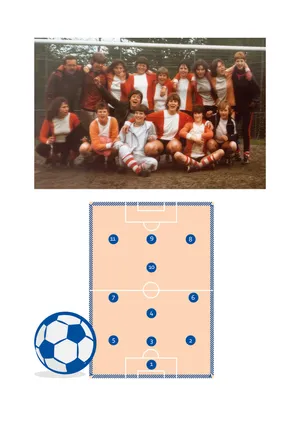
The family constellation works because the human body can sense a situation: representative perception. Wim had discovered that capacity himself, as a football coach, and had been applying it for twenty years before he ever encountered the phenomenon in the family constellation.
He discovered it ‘by chance’. There was no board at hand during a tournament, so he literally placed the players in the space, in the planned formation. The non-verbal reactions between them made it immediately visible, and palpable, how well players standing close together could cooperate. Where the distance between two heads is smaller than the distance between their feet, the relationship is good. As a coach, you can use that to optimize the mutual positions and agreements psychologically.
Spatial team formation has two major advantages over the board, which is still the common approach in football.
- You place the players who get along well with your star player around them, in line with the Cruyff method.
- The better the mutual relationships, the freer the joint division of tasks.
Brand perspective on positioning
The original English name for the family constellation is Family Positioning, a term directly in line with the core English term within marketing: Brand Positioning. Family members are positioned relative to one another in space; brand elements are positioned relative to one another in a graphic space. The move is the same.
Thinking of brands as systems, and of brands as people, is common currency among brand experts, as is the fact that 99% of received information is processed subconsciously. That made carrying family and organizational issues over to brand issues a natural step for them. To align well with the world of brands, the term Wim used in his doctoral research (2010) was systemic brand research. The tower logo of the branding constellation derives from the owl symbol of Wim Jurg Branding and refers, inherently, to Rilke’s tower: a metaphor for the divine, an essence so immeasurable and mysterious that one can never fully know it.
Branding constellations as interventions
Wim Jurg spent 25 years at the Open University, where he taught Intervention and Change Management alongside (market) research and branding, among other subjects. So he came to a brand decision ‘naturally’ as an intervention in an existing brand situation.
That makes the branding constellation a solution-oriented form of coaching: the point is to improve the current brand situation step by step, not to conjure a magical solution to it. And working on solutions gives brand decision-makers far more energy than talking about problems does.
Research into branding constellations
Alongside the research in his doctoral thesis, Wim spent fifteen years supervising students who graduated from the Open University with a thesis on branding constellation. That research shows the methodology to be relevant, valid and reliable, according to the brand decision-makers and the brand experts present alike.
During a branding constellation, the decision-maker’s brain appears to go looking for the logic behind the representatives’ behavior, and in doing so activates information the decision-maker had processed subconsciously. That clarifies whether doubt about a brand decision stems from implicit brand knowledge, or from a system that wants to keep everything as it is now. Decision-makers also turn out to recognize what the representatives of their brand elements say.
Constellations held at different times by the same MT members yield similar results, and where the outcomes of different MT members differ, the difference traces back to their differing perspectives on a brand decision; see also literature. The various constellations run within the framework of the Basic Branding Constellation Training point the same way.